The Invisible Lines Shaping Where Bars, Restaurants, and Package Stores Can Open in Fairfield County
Well-designed cities organize human needs. They give shape to where we live and work, but also where we make friends, celebrate our birthdays, and go on dates. But who decides where all the bars and restaurants actually go? “How and where people enjoy themselves after sundown is almost always controlled by zoning,” writes Sara C. Bronin, author of Key to the City.
Zoning codes typically contain the rules governing the location of dining and nightlife venues, but—while publicly available—regulations often confound business owners. At CT Liquor Permit, we navigate local regulations on an everyday basis, allowing us to maintain a catalogue of all the variations. It’s our job to lift the curtain. So, in this article, we’re sharing our findings on distance requirements across Fairfield County, home to the Gold Coast of Connecticut and several mid-sized cities—as well as vibrant rural areas. Unlike other states, Connecticut has abolished county governance, so liquor permit approvals depend upon both municipal discretion and compliance with the state regulatory body.
First, some terminology. One of the main purposes of zoning is to space things out. That’s often accomplished by grouping certain activities in certain areas, or zones. Most zoning codes include a use table, listing the zones that allow certain business types to operate. For example, a city may allow only restaurants with wine and beer permits in specific zones, as Danbury does.
However, a location’s zone is not the last word on whether a business can obtain a liquor permit there. Even within zones, businesses usually have to conform to separation rules that ensure liquor permit holders are not too close to churches, schools, or even other alcohol-serving establishments. Furthermore, while some zones allow bars or restaurants “by right,” others allow them only after an approval process. A business may need to apply for a special permit (or in some cases, a special exemption), which gives zoning an opportunity to exercise judgment.
Let’s break down how Fairfield County municipalities think about spacing differently. We’ll start by examining what sorts of requirements apply and to whom. Then, we’ll discuss variation in zoning enforcement, before finally presenting some insights for businesses looking for a compliant venue that suits their concept.
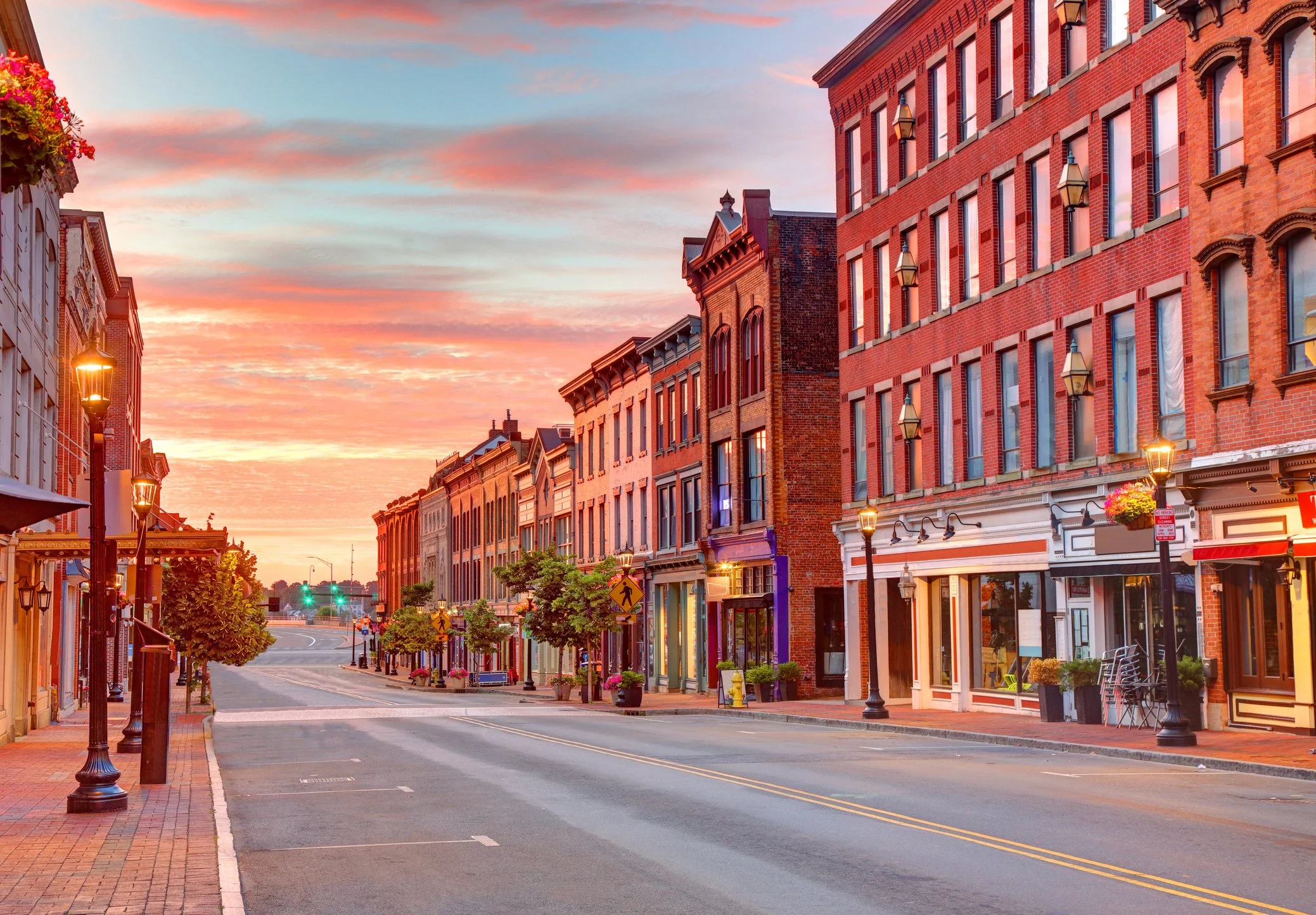
Washington Street, South Norwalk
How Separation Rules Vary
There are two main types of separation rules: clustering and sensitive use. Clustering rules typically apply to package stores, preventing more than one from occupying a given area.
In fact, the State of Connecticut imposes strict control over package stores, allotting just one package store permit per 2,500 residents in each municipality. Clustering rules further narrow the available options for new locations. Sensitive use rules often apply to multiple types of businesses in order to set them apart from protected areas (e.g. schools).
Brookfield, for instance, prohibits a new package store from opening within 2,000 feet of an existing one—measured along street centerlines rather than as the crow flies. Newtown applies a different logic, setting a 300-foot buffer between package stores or taverns and sensitive uses like schools and churches. However, Newtown exempts restaurants and cafés from that requirement entirely.
Not all numerical rules work the same way. Fairfield applies what might be called a same-class rule: establishments are only required to maintain separation from permit holders in their own category. A package store must keep its distance from another package store, and a café from another café, but a package store can plant to open right beside a café without triggering scrutiny. Stamford takes a more dynamic approach, calibrating the required distance between package stores based on the zone under the city's Master Plan. A shorter buffer applies in denser, mixed-use core areas, and a longer one elsewhere, effectively accommodating urban density while maintaining some control in suburban neighborhoods. Bethel goes further, waiving its separation requirements entirely within three commercial zones.
How Zoning Governs Spacing
Municipal governance of liquor permits falls into three buckets. First, we have municipalities that list explicit rules as we saw above—typically codifying numerical distances to achieve the spacing they want. This is the most common framework. The principle behind the zoning sign-off is specific, transparent, and predictable.
Second, we have municipalities in which zoning officials approve alcohol-service at their own discretion—in those cases, the code generally explains the relevant factors at play, including separation from other establishments. Five Fairfield County municipalities fit the bill: Bridgeport, Danbury, Monroe, Stratford, and Trumbull. Here zoning codes require officials to consider how alcohol service may affect the surrounding neighborhood. They may even consider the permit type (e.g. full-service liquor vs. wine and beer permits) as well as planned activities at the location (e.g. live music).
Stratford’s code is most stringent, requiring a special permit for all establishments that sell alcohol. At least four Zoning Commission members must vote in favor to approve new liquor permit locations. Stratford considers the concentration of other liquor permit establishments in a given area, plus proximity to churches, schools, and places frequented by minors. Trumbull’s framework mirrors Stratford’s, considering exactly the same criteria.
Bridgeport’s code is most unique. The city requires all liquor permit applicants to obtain a Certificate of Location Approval, or CLA. The zoning department grants such certificates only if they deem the project to be consistent with the needs of the neighborhood, an attempt to safeguard residents and businesses in the vicinity from disruption, conflict, and other impacts of alcohol service. That said, full-service restaurants outside the N or NX zones are exempt from the CLA approval process.
Third, we have municipalities that barely contemplate alcohol service and say very little about dining and nightlife. For example, Easton, whose code lists no commercial zones, is often considered a damp town (not quite a dry town, but still rather restrictive). Easton hosts a lone Café Permit at a golf course as well as a single Grocery Beer Permit held by Greiser’s Coffee & Market. Rural towns like Redding, Sherman, and Weston are similar; although their codes lack restrictions on bars and restaurants, they also contain sparse allowances for such businesses.
Where We Find Leniency
Surprisingly, not every Fairfield County municipality imposes separation rules. Darien, Greenwich, Norwalk, Ridgefield, and Westport have no separation requirements on the books at all. Darien's absence is particularly notable as the town once had proximity rules for package stores, but repealed them in 2000.
Across the county, roughly eight municipalities explicitly exempt restaurants from their separation requirements, and several of those extend the exemption to cafés as well. The logic is consistent even where the rules differ: restaurants are understood as food-first businesses where alcohol is incidental, while package stores are alcohol-first businesses where the regulatory concern is more acute. Bethel, for example, exempts restaurants from its clustering rule while still holding them to a sensitive-use buffer, a distinction that reflects this intuition. Newtown goes further, exempting not just restaurants and cafés but also brewpubs and distilleries (as long as they serve food). Shelton takes a different path—rather than a formal exemption, its code simply doesn't restrict restaurants or cafés at all, leaving its active downtown to develop without proximity-based interference.
What Questions Remain Open
The above analysis excludes two Fairfield County towns: New Canaan and New Fairfield. At the time of writing, both towns’ zoning codes are under review, but expect changes to be announced in the coming months. Furthermore, while five municipalities list discretion-based criteria for committees to consider, the sign-off is ultimately a judgment call. How exactly these approvals play out in practice depends on the locale’s current state of play and on the business’s characteristics for a given applicant.
Zoning codes are living documents, and zoning departments are living institutions. Getting a project approved requires understanding the landscape as a whole, such as the location’s history, the intention behind the zoning criteria, and the unwritten rules employed by city officials. At CT Liquor Permit, we pride ourselves on maintaining in-depth knowledge of local processes. To learn how to obtain approval for your business, contact us for more information.